File Your Air Transportation Excise Tax Online With An IRS-Authorized
Portal Designed for Quick and Easy Form 720 Filing
- No Software to Download
- Instant IRS Confirmation
- No Contracts Required

What Are Communications and Air Transportation Taxes?
Communications and Air Transportation Taxes are federal excise taxes reported on Form 720, Quarterly Federal Excise Tax Return. These taxes apply to certain communication services and taxable air transportation transactions under IRC Sections 4251, 4261, and 4271.
They include:
Applies to certain local telephone and teletypewriter exchange services.
Applies to taxable passenger air transportation, including domestic segment and percentage-based taxes.
Applies to certain international air transportation beginning or ending in the United States.
Applies to taxable air transportation of property.
Who Pays Communications and Air Transportation Taxes?
The tax is generally paid by the customer purchasing the taxable service or transportation. However, the person receiving the payment for the taxable service is responsible for collecting the tax, reporting it, and paying it to the IRS through Form 720. Below are the examples:
A telephone service provider collects communications tax from customers and pays it to the IRS.
An airline or air transportation provider collects applicable air transportation taxes from passengers or customers and pays it to the IRS.
An air cargo provider collects tax on taxable property transportation charges and pays it to the IRS.
Communication and Air Transportation Excise Tax Filing Requirements
| Category | Details |
|---|---|
| IRS Number | 22 (Local telephone service and teletypewriter exchange service) 26 (Transportation of persons by air) 28 (Transportation of property by air) 27 (Use of international air travel facilities) |
| Reporting Section | Part 1 |
| Filing Frequency | Quarterly |
| Tax Rate | 22 (Local telephone service and teletypewriter exchange service) – 3% of taxable amount 26 (Transportation of persons by air) – 7.5% of ticket price for percentage tax and $5.30 for segment tax 28 (Transportation of property by air) – 6.25% of ticket price 27 (Use of international air travel facilities) – $23.40 per passenger |
| Tax Calculation Formula | 22 (Local telephone service and teletypewriter exchange service) - Monthly taxable telephone service charge x 3% 26 (Transportation of persons by air) - Percentage tax = Ticket amount × 7.5% and Segment tax = No. of Domestic segments × $5.30 28 (Transportation of property by air) - Air cargo transportation charge x 6.25% 27 (Use of international air travel facilities) - Passengers x $23.40 |
| Details Required for Calculating the Tax Amount | 22 (Local telephone service and teletypewriter exchange service) - Taxable telephone charge amount 26 (Transportation of persons by air) - Ticket amount, no. of segments 28 (Transportation of property by air) - transportation charge 27 (Use of international air travel facilities) - No. of passengers |
Communication and Air Transportation Excise Tax Due Dates and Penalties
| Quarter | Tax Period Covered | Form 720 Due Date |
|---|---|---|
| Q1 | January 1 – March 31 | April 30 |
| Q2 | April 1 – June 30 | July 31 |
| Q3 | July 1 – September 30 | October 31 |
| Q4 | October 1 – December 31 | January 31 (following year) |
If you fail to file Form 720 for your air transportation tax by the
applicable due date, the IRS may impose penalties and interest.
Common penalties
include:

Generally 5% of the unpaid tax for each month or part of a month the return is late, up to 25%.

Generally 0.5% of the unpaid tax for each month or part of a month, up to 25%.

Interest may accrue on unpaid taxes from the applicable due date until the balance is paid.

Additional penalties may apply when required federal tax deposits are late, insufficient, or not made using the required method.
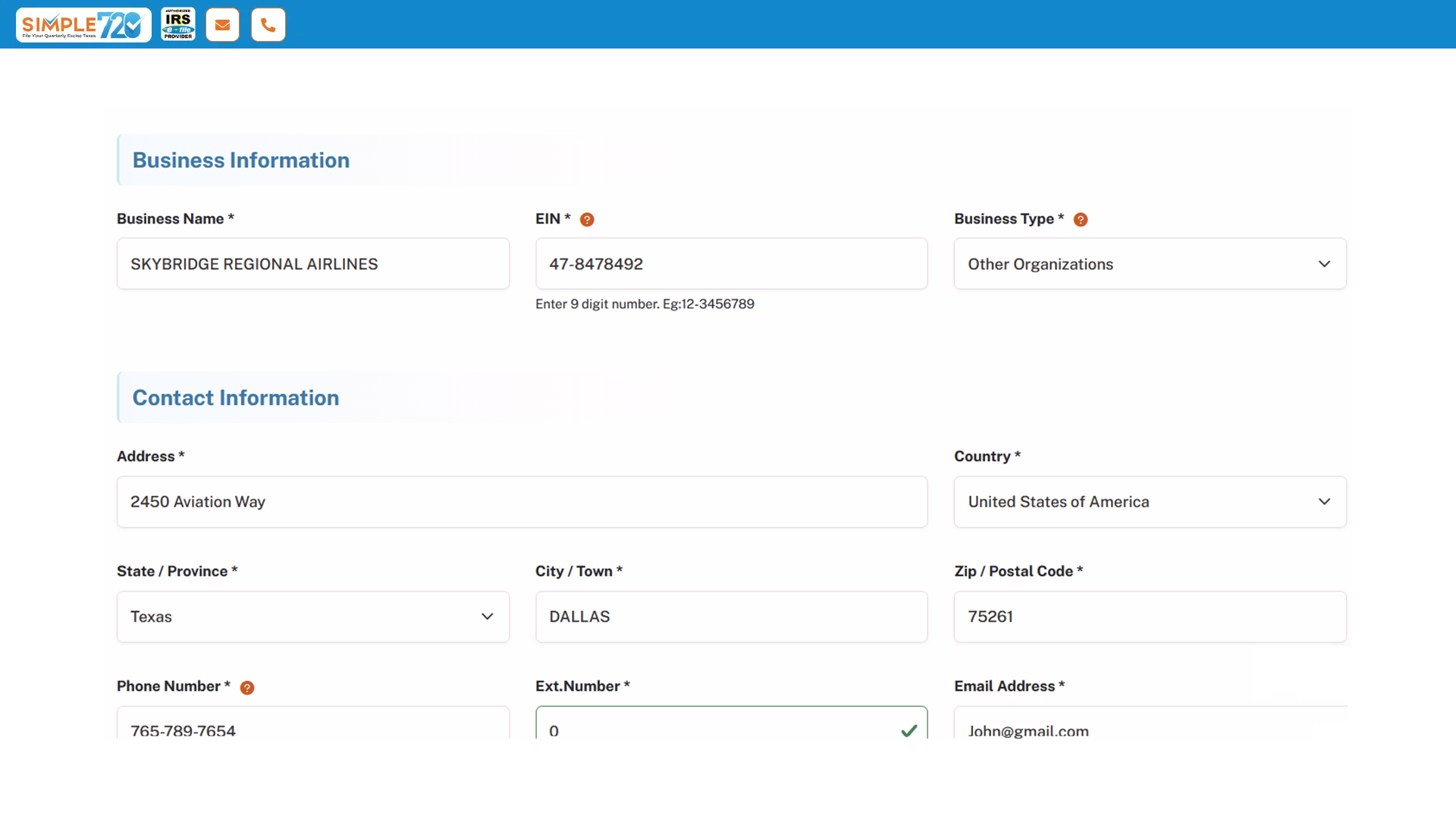
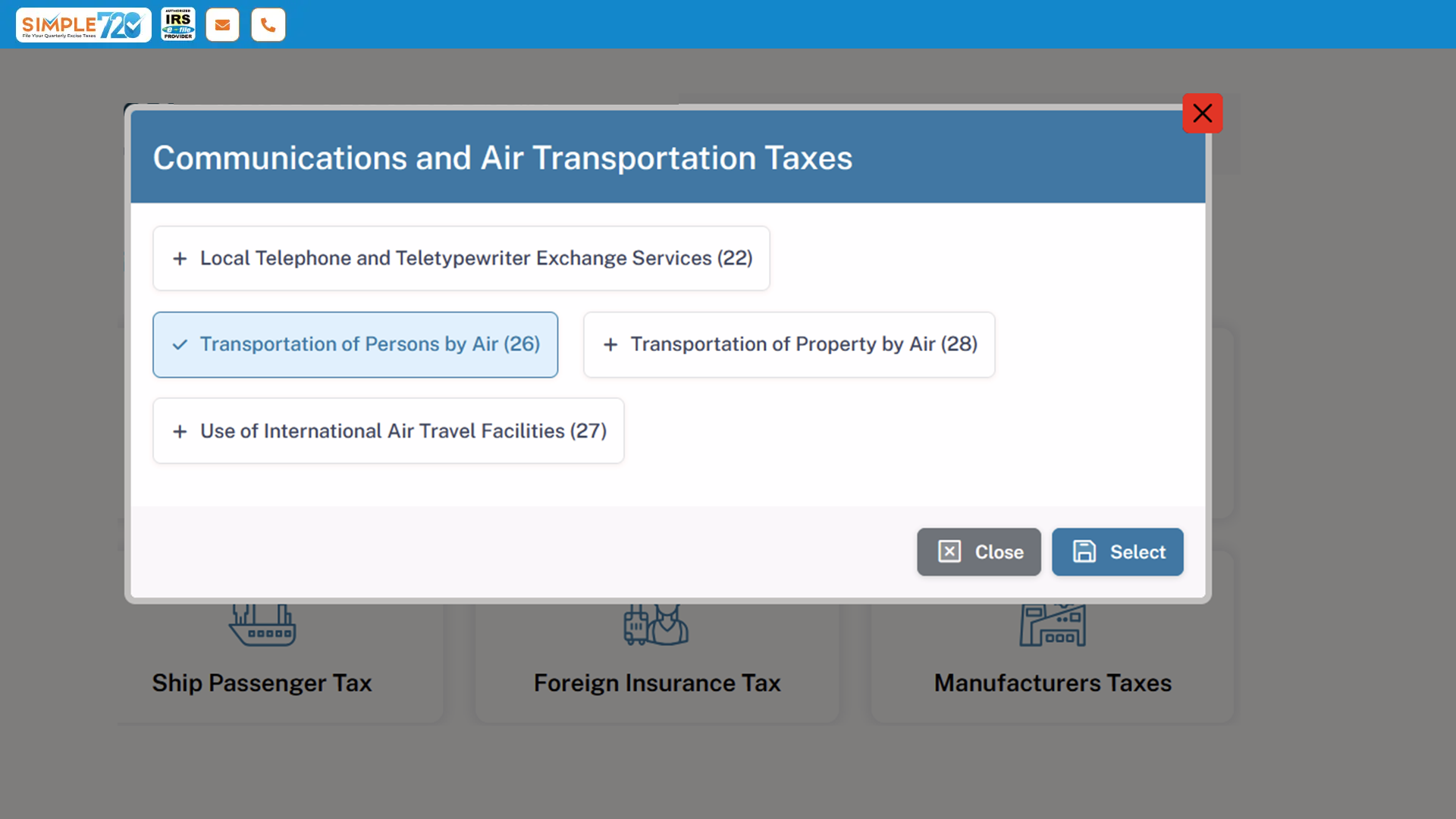
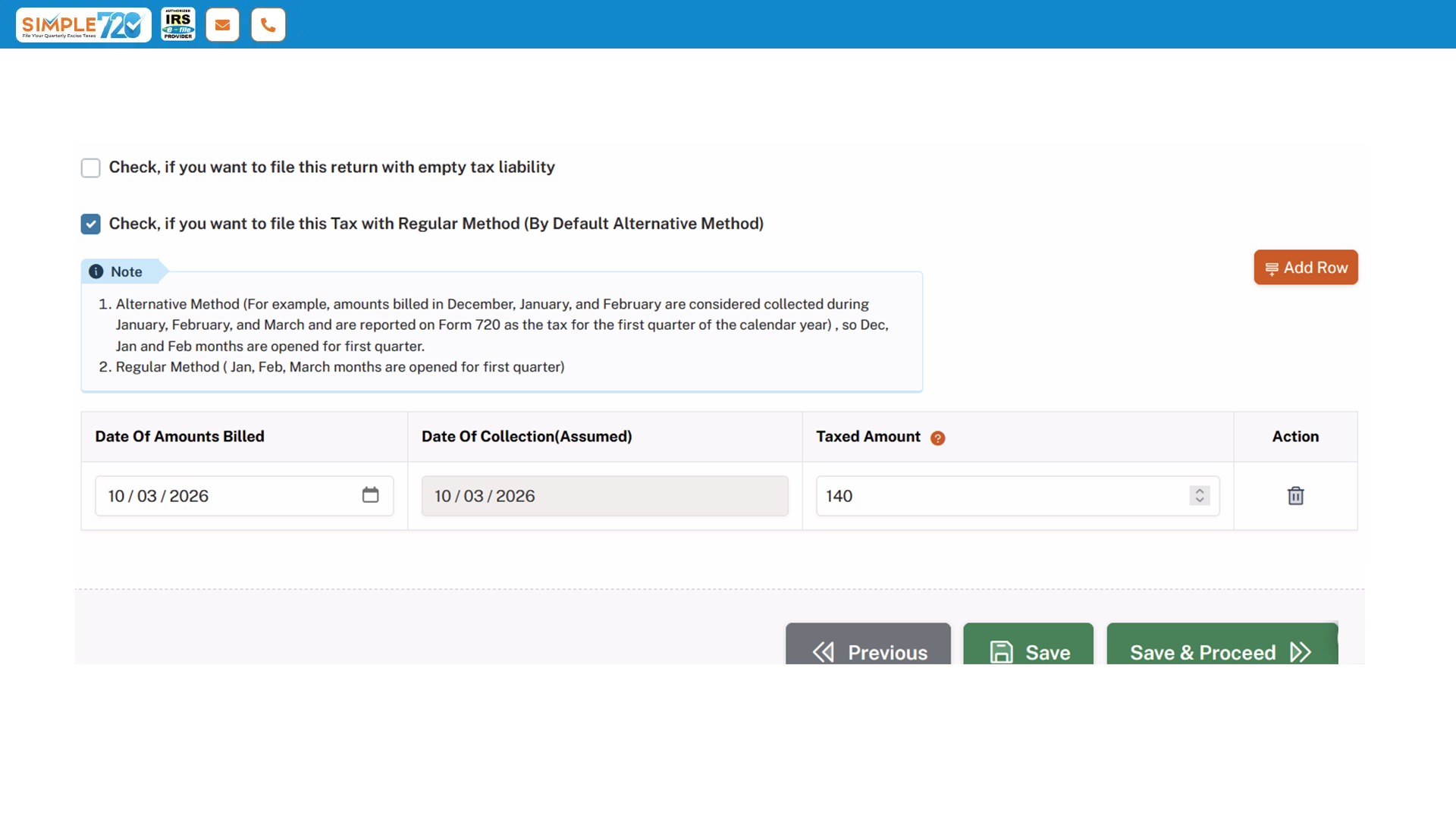
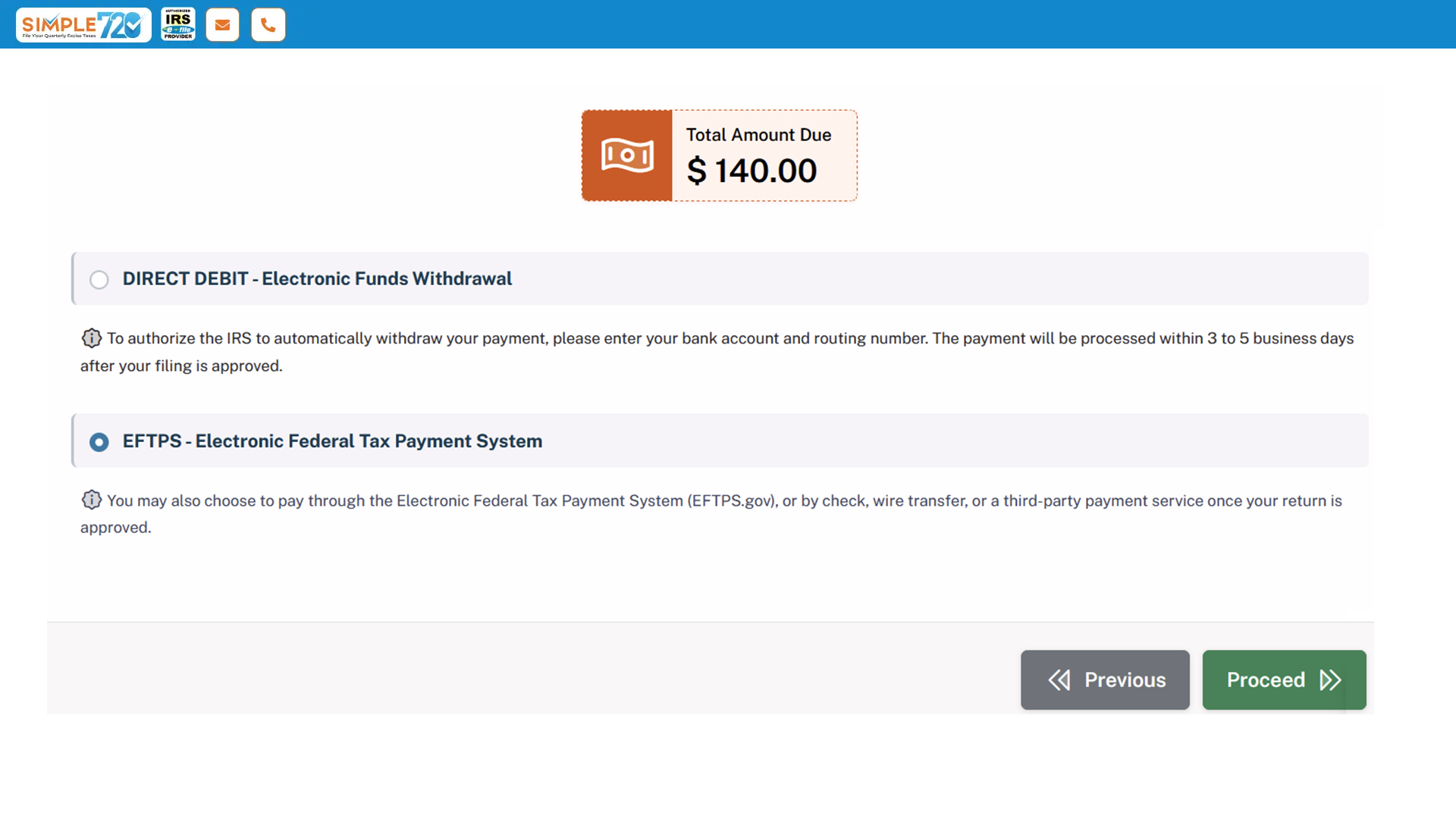
How to file Communication and Air Transportation Excise Tax online with Simple720?(easy 4 Steps)
details
the Tax category
Tax details
your payment
Why Choose Simple720 for Filing Your Communication and Air Transportation Tax?



Simple720 vs Other Providers vs Manual Filing
| Filing Features | Simple720 | Other Providers | Paper Filing |
|---|---|---|---|
| Software Download | Not required | May be required | Not applicable |
| License | No license | May require license | Not applicable |
| Contract | No contract | May require contract | Not applicable |
| Cost | Affordable pricing | Often higher cost | Moderate |
| Filing Speed | Fast online filing | Varies by provider | Slower filing |
| Ease of Use | Simple guided process | Platform dependent | Complicated manual process |
| Efficiency | Highly efficient | Varies by provider | Less efficient |
| Tax Calculation | Automatic calculation | Provider dependent | Manual calculation |
| Support | Dedicated support | Limited support | No support |
| Overall Experience | Fast and simple | Varies by provider | More manual effort |

Efficient and Error-Free Filing Simple720 made filing our air transportation and communications taxes easy — no more guessing IRS categories or worrying about mistakes.
Clear Guidance Through Complex Rules Understanding segment taxes and international travel facilities tax used to be confusing, but Simple720 walked us through every step.
Reliable and Time-Saving Solution Switching to Simple720 for our communications and air transportation excise tax filings saved us hours each quarter.
Frequently Asked Questions
Wondering how Communication and Air Transportation Excise Tax filing works on Simple720?
Our excise tax experts are here to guide you through every step of the process.
Book your free live demo today and discover how simple and accurate your
Form 720 filing can be.